This is quite an unusual painting, as you can see. So, rather than leave you to work it all out, I’ll tell you what was going through my mind when I designed and painted it and why it will stick in your own mind too.
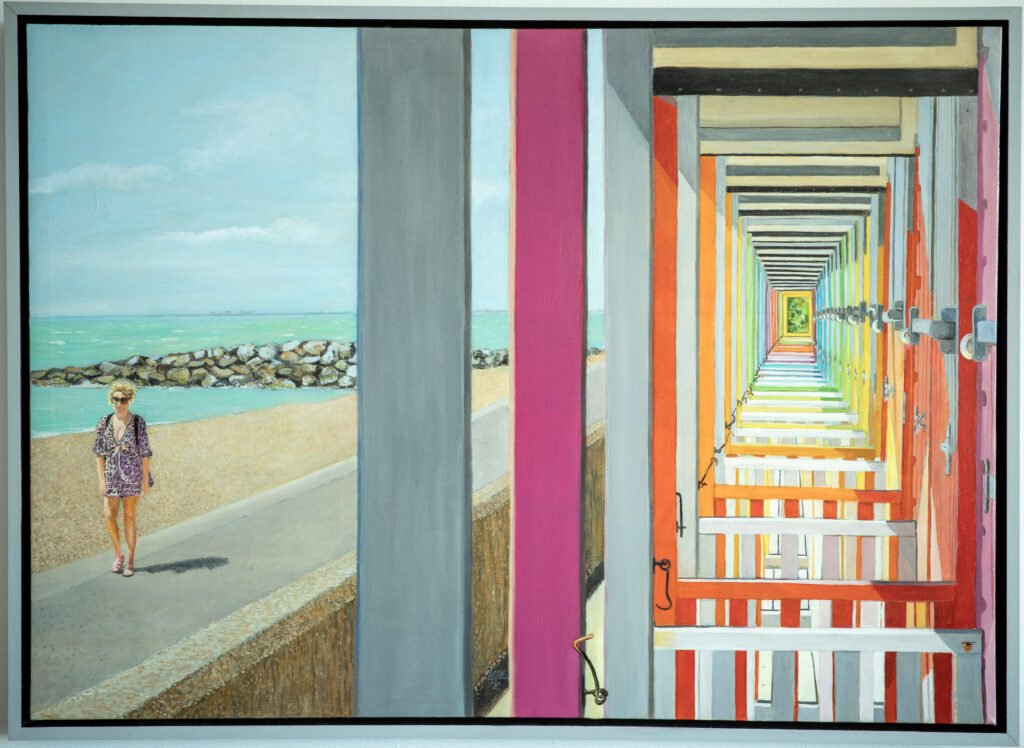
The first thing that struck me was the contrast between the woman walking through the scene and the world around her.
She is caught in a passing moment. She’s walking through the landscape, listening to something on her AirPods, probably thinking about something completely unrelated, and will soon disappear from the scene.
But the painting has frozen that ordinary moment in time.
Meanwhile, the rows of coloured beach huts are like a box of candy that you can’t dismiss without further investigation. They also have a very different relationship with time. They are familiar, functional and always there. We pass them again and again without necessarily noticing their remarkable geometry or, in this case, their extraordinary colour scheme.
From this particular angle, though, they become almost monumental. Alongside the woman, the beach huts exist in a literal parallel universe. They are right beside her, but they seem to belong to an entirely different world.
The perspective turns the huts into a tunnel, drawing your eye towards a distant point and making you expect the journey to lead somewhere.
It doesn’t.
The apparent destination is a dead end — and, on closer inspection, it might even be the same vanishing point from which the woman entered the scene.
Then your eye gets pulled somewhere else.
The dark pink support post is deliberately placed right in the middle of all this. It’s just an ordinary part of the beach huts, but its colour and position make it difficult to ignore. Your eye moves into the tunnel, back towards the woman, across to the pink post and then out into the wider landscape, almost for a breath of fresh air.
You never quite settle.
That is deliberate.
I wanted the painting to create a little agitation in the way you look at it. Just when you think you’ve worked out where to look, something else catches your eye and sends you back into the picture.
I’ve found that you have to live with it for quite a while before your eyes finally make peace with it. And that’s where the title, Meanwhile, comes in.
While the woman is passing through the scene, everything else simply carries on. The beach huts aren’t going anywhere. The landscape doesn’t care where she’s going. For a brief moment, all these different experiences of time occupy the same picture.
Perhaps that’s the point.
We spend so much of our lives moving through the world without really seeing it. We head down our own tunnels, often completely absorbed in where we think we’re going, while the world around us quietly carries on.
Perhaps that’s the other reason the tunnel in this painting matters. It looks as though it must take us somewhere, but it doesn’t. Maybe our own journeys aren’t always as purposeful as we imagine either.
So perhaps we should stop occasionally, look around and actually notice what is there. These moments are easily missed as we head down our own tunnels… maybe also going nowhere!
We’ll leave that question for another day!
Prints
Full-size archival prints of Meanwhile are available, produced for me by a Platinum-certified printshop on museum-grade Hahnemühle archival paper.
They are stunning reproductions of the original, retaining the size, colour, detail and atmosphere of the painting.
Full size — 500 × 700mm — £200
A3+ — 12″ × 16.8″ — £99
Custom sizes are also available.
Email me for details.
A print of Meanwhile is an image that keeps revealing itself. There’s a lot going on in it, and I think you’ll notice different things the longer you live with it.