I’ve written this essay to explain why prints are nothing to be scared of, and why I think they are the best way to enjoy art in an affordable way.
When you simply can’t buy or afford an original piece of art, or when the size doesn’t fit your house, but you love the image, what options are you left with? Prints of course!
These days, printing is an incredibly accurate and representational process. They might be given the fancy name of Giclée, but they are just inkjet prints made with superior printers, inks and papers. And surprisingly, they only need to be scanned and printed at 300 dots per inch. This is considered very low by computer buffs, but is plenty to print at the same size as the original while still leaving your eyes the impossible task of seeing any digital granularity. The inks and papers are stable, of museum archival quality, and more than capable of outlasting an original painting! Canvas isn’t as resilient as one would like to think, so if taking care of an original isn’t for you, then prints are a great alternative. Just insist on the best quality.
When artists issue prints, they often like to restrict the numbers printed in order to create some sort of rarity that resembles an original. They then number them 1/50 for example. Is there any advantage to paying more for this rarity? Not in my opinion. IF, and it’s a very big IF, you are looking at investing in your print with the intention of trading it at some point in the future against a very well known artist who may have died for example, then it’s possible that the value could increase if there’s competition in the perceived rarity. You are also getting involved in auctions, fees, capital gains tax etc. But most of us simply want to enjoy the image! There’s no point in paying for this rarity from any normal artist. Knowing that there might be 25, 50, 250 other owners of the image really shouldn’t bother you. What counts is that you have that image. You still own a share of the artist’s work for your own enjoyment.
The traditional way of finishing a print is for the artist to sign it underneath in pencil. Again, in my opinion, this is pointless. (Whoops!). It uses space at the bottom of the print which the mat has to be cut around, which I think unbalances the image. If you’ve ever seen one of my original paintings, you might think that I’ve not signed that either! I’ll let you into a secret….
When I was 15 and studying for my art exams, I started to sign my pictures with a symbol instead of my name. I did it in different places on each picture. And I’ve done it ever since. This was well before Prince copied me😂. So you’ll know that an original or a print is mine once you find it, and when I’m dead/famous, you can take it to the BBC’s Fake or Fortune for analysis!
Why do I think that prints are better than originals? Imagine spending ten thousand pounds on an original. You might need to insure it against disaster, there’s always a fear of it being stolen, damaged during moving house, or God forbid, a fire. The outcome of this is that your expensive insurance might refund the value originally declared, but if it has increased in value, that might be harder to prove. And the actual painting may be lost forever! It’s actually irreplaceable. Think about that for a minute!
But then there’s a print! A print is much cheaper to buy, causes less stress during ownership, and if the worst happens, it actually could be replaced in many cases; disaster averted.
Additionally, you can get a print made to any size. This enables you to have your chosen image to fit a limited space. Having been to my printers to inspect their work, I literally can’t tell the difference at viewing distance between my painting and their printing. Printing actually looks more uniform too. We can analyse Van Gogh’s brush strokes, but that’s history. Today, it’s irrelevant in my opinion unless you are specifically looking for sculptured textures. And there are now high end printing techniques that can show some texture.
Now, talking about my own prints to give you more clarity, we’ll start with a rough rule of thumb on cost: A full size print should be around one tenth of the original in price, and a half size print about one twentieth. That’s what I try to base my print prices on. That gives you a significant saving, and still allows you to own my work and enjoy the image that you love. I can also arrange for your print to be exactly the size you need to fit your space. I only use the best paper, made in Germany by Hahnemüle, and one of their Platinum grade print shops. This is the very best quality available anywhere. They scan, edit and exactly match the print to the original painting colours. Even I can barely see the difference.
Artist editions. What are these? I am also mounting my prints in a special way to make them look like original paintings. No glass. No deep mat borders. So they don’t even look like prints! I hand make the frames too. You end up with a print that is barely indistinguishable from one of my paintings. And your house guests won’t have a clue what’s happened as they look so real.
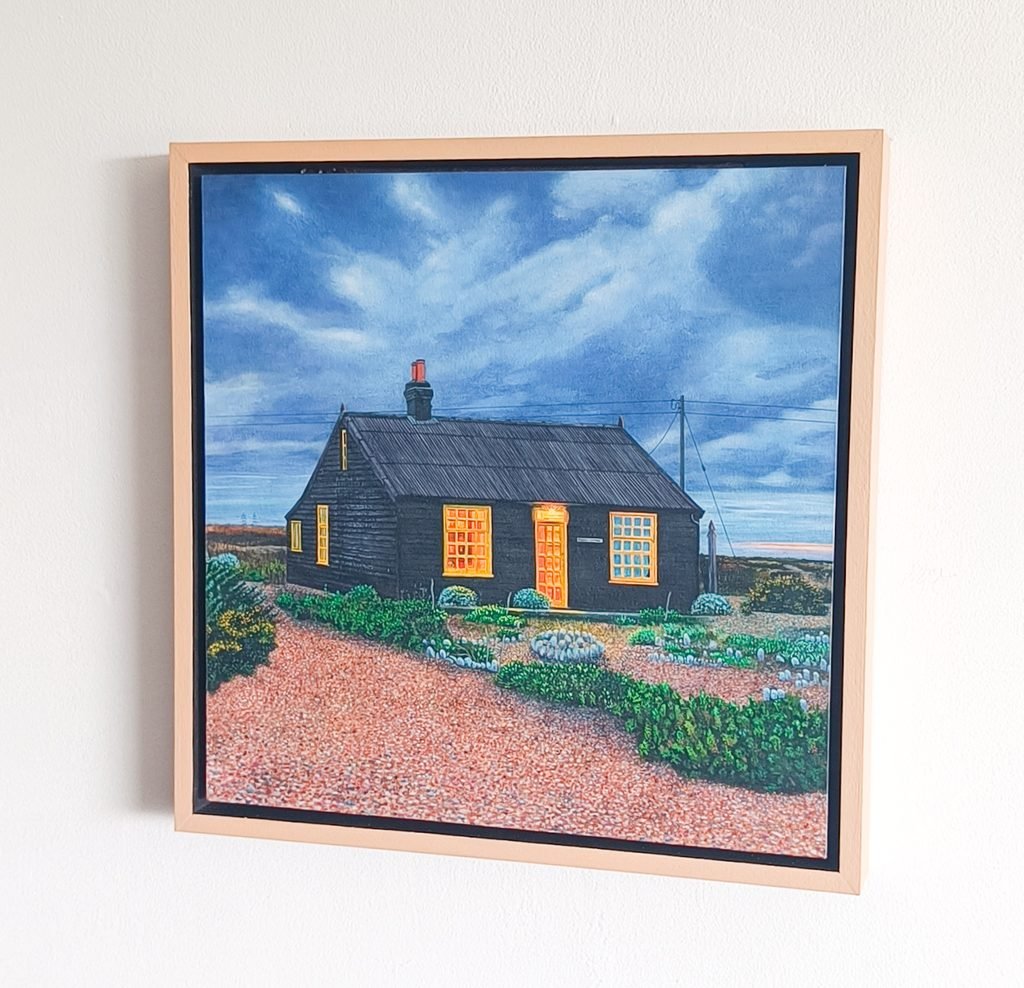
Additionally, I am making a very special offer for owners of my prints. If the worst does happen to occur, let’s say a burst radiator pipe upstairs, dripping through the ceiling onto your art collection, I will authorise you to make another copy. You will only have to pay for the actual reprinting and framing costs yourself, with no additional fees to me whatsoever to replace your rights on the image. I think this is very fair and transparent, and I challenge anyone to replicate this offer. It’s probably unique in the art world.
So, there’s my feelings about prints.
I hope you found this essay informative and interesting, and can see why prints are the economical way to buy into artworks worth over ~£500. If you have any further questions, please ask. All of my work that is currently available to print can be found here.